
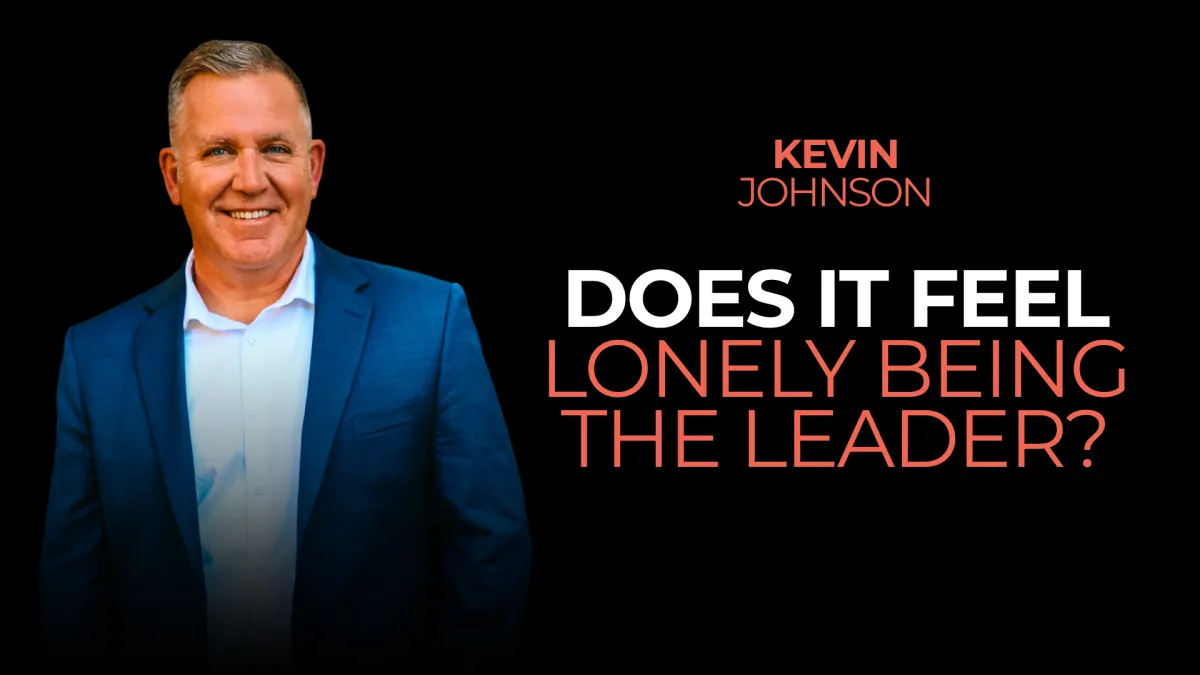
Does It Feel Lonely Being the Leader?
If you’re leading anything of consequence, my assumption is your answer is yes.
Leadership can feel isolating, not because you lack people around you, but because you carry responsibility they don’t. You see risks they don’t. You see opportunities they don’t. And sometimes, when you articulate a direction, the very people who are supposed to be in your corner push back.
I decided to write this after a recent exchange with a strong client who was visibly frustrated. Their comment was direct and accurate:
“Don’t question me because you don’t see it. Question me to understand my vision.”
That statement captures the tension many leaders feel but struggle to articulate.
The problem is not questions. The problem is intention.
And if you don’t learn how to differentiate between the two, leadership will feel lonelier than it needs to be.
The Core Insight: Leadership Is Lonely When Intent and Alignment Are Misread
Not all questions are equal.
Some questions come from curiosity and commitment.
Some come from insecurity.
Some come from resistance.
Some come from ego.
If you treat them all the same, you will either become defensive, or naive.
Leadership requires emotional maturity and situational awareness. You must discern whether a team member is asking to understand or asking to undermine.
That discernment is where many leaders struggle.
Some leaders dislike being questioned at all. They interpret every inquiry as defiance. That posture shuts down dialogue and eventually erodes trust.
Other leaders tolerate endless questioning without evaluating intent. That posture invites subtle sabotage and erodes authority.
Neither extreme works.
People Process Information Differently
One of the simplest realities leaders forget is this: people are wired differently.
Within any team, you’ll typically find three general categories:
Believers– They trust you enough to move forward without much detail.
Executors– They’re comfortable being told what to do and implementing.
Processors– They need to understand the “why,” the path, and the logic before committing.
None of these are wrong.
The leadership mistake happens when you expect everyone to process like you do. If you are a high-conviction visionary, you may grow impatient with detailed questioning. If you are analytical, you may expect everyone to want the same level of depth.
Effective leadership adapts to the individual.
For some team members, you should welcome questions, and even create the standard that you expect them. Dialogue builds understanding. Understanding removes friction. Friction is what kills execution.
Questions asked from the right place accelerate alignment.
When Questions Are Not Coming From the Right Place
Here’s where leadership gets more nuanced.
Not all questioning is healthy.
Sometimes questions are a disguise for:
Protecting the status quo
Avoiding change
Undermining authority
Demonstrating superiority
Creating a self-fulfilling prophecy of failure
When someone consistently questions direction not to understand but to disprove, the tone shifts. The energy shifts. The outcome shifts.
And if that person holds influence, formal or informal, the impact multiplies.
This is where leaders must be clear.
You should welcome questions for clarity about the vision.
You should not tolerate questioning that is rooted in bad intent.
Intent matters.
A Principle Worth Remembering: Oxygen vs. Starvation
In my work, I often refer to the concept of oxygen versus starvation.
Whatever behavior you give oxygen to grows.
Whatever you starve eventually fades.
If you give oxygen to unhealthy skepticism disguised as curiosity, you will grow internal competition. If you give oxygen to honest inquiry and constructive debate, you will grow alignment.
Leaders must be intentional about which behaviors they reinforce.
This does not mean reacting emotionally. It means responding strategically.
For team members asking from a good place, invest time. Explain the vision. Invite dialogue. Build understanding.
For those questioning to maintain comfort or create friction, be direct. Clarify expectations. Set boundaries. Remove ambiguity.
There is enough competition outside your business. You do not need it inside your business.
Real-World Application
In practical terms, this tension shows up in subtle but powerful ways:
A department head publicly questioning a strategic shift because it threatens their control.
A senior team member asking repetitive “what if” questions that stall momentum.
A high performer challenging direction because they genuinely want to improve execution.
From the outside, all three look similar. From a leadership standpoint, they require very different responses.
If you respond to constructive questioning with defensiveness, you discourage engagement.
If you respond to undermining behavior with excessive patience, you weaken authority.
Leadership is not about suppressing questions. It is about shaping the culture around how questions are asked, and why.
When leaders establish the expectation that questions are welcomed for clarity but not for sabotage, performance improves dramatically.
Why Leadership Feels Lonely
Leadership feels lonely because you often carry vision before others see it.
You are responsible for:
The direction
The risk
The outcome
Your team carries execution. You carry consequence.
When you are questioned in a way that feels misaligned or disloyal, it amplifies that isolation. But loneliness in leadership is not a sign you are doing it wrong. It is often a sign that you are operating at a different altitude.
The key is not eliminating the loneliness. It is building the right kind of dialogue around it.
Who This Is For
This perspective is for:
Business owners frustrated by internal pushback
Managers struggling with authority among peers
Entrepreneurs scaling teams and experiencing cultural friction
Leaders questioning whether they are too rigid, or not firm enough
If you feel tension between maintaining authority and encouraging openness, you are not alone. But that tension must be managed deliberately.
Final Thought
The goal is not to silence your team.
The goal is to align them.
Encourage questions that clarify vision.
Confront questions that undermine it.
And remember: leadership is not about being unchallenged. It is about guiding challenge toward progress.
If you want clarity on how to lead with conviction while building alignment, not resentment, inside your organization, let’s talk.
Let’s talk.
Written by Kevin Johnson, CEO and Founder of Leverage Consulting.