
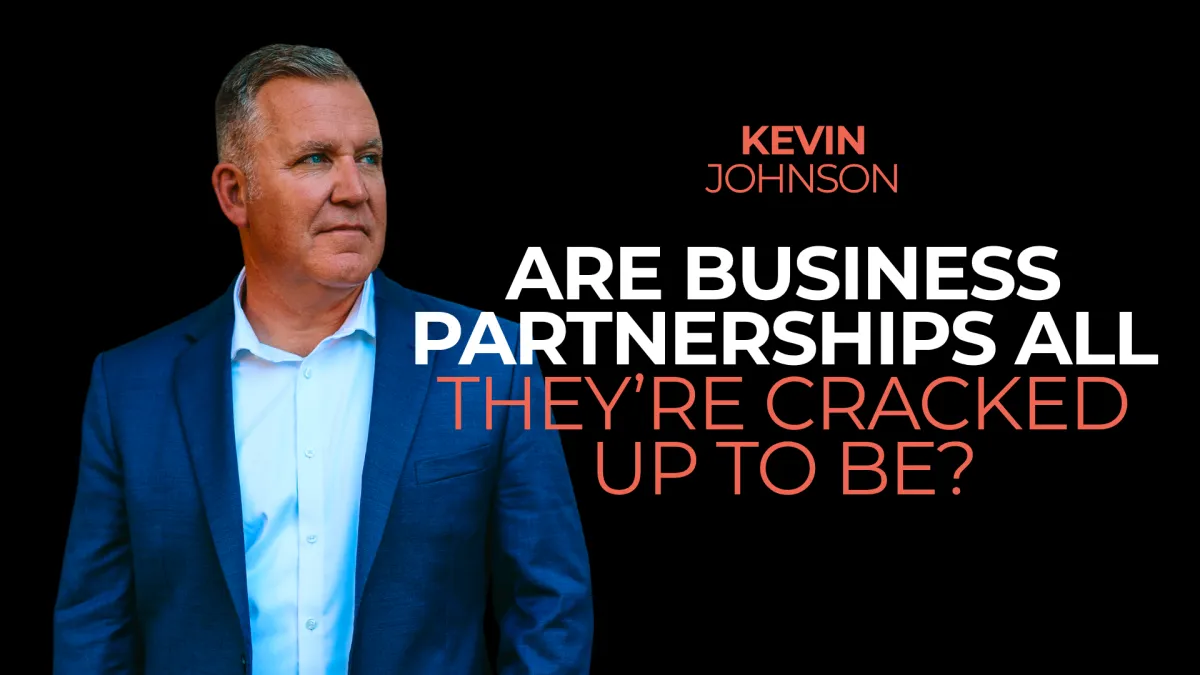
Are Business Partnerships All They’re Cracked Up to Be?
On paper, partnerships sound powerful.
Two talented people. Shared passion. Complementary skills. Bigger vision. Shared risk. Shared reward.
It feels like leverage.
And sometimes it is.
But after more than 25 years working with service-based entrepreneurs, professional practices, and leadership teams, I can tell you this with certainty: shared passion or shared profession is not even close to enough to build a successful partnership.
It’s a starting point for a conversation. It is not a foundation for a structure.
Most partnerships don’t fail because the people are bad. They fail because the expectations were vague, the roles were blurry, and the difficult conversations were postponed.
That’s not a personality issue. It’s a design issue.
The Core Insight: Partnerships Work When They’re Architected—Not Assumed
A strong partnership is not the natural result of liking each other or thinking similarly.
It is the product of deliberate design.
Years ago, when my wife Shelley and I were married in the Catholic Church, we went through a process called Pre-Cana. It’s essentially premarital preparation. Structured conversations about values, expectations, money, conflict, and long-term direction.
At some point, I had an epiphany: we should be doing the same thing for business partners.
Because the parallels are obvious.
Business partnerships involve:
Shared financial outcomes
Shared decision-making
Shared reputation
Shared long-term direction
In many cases, you’ll spend more waking hours with your business partner than with your spouse. Yet many partnerships are formed with nothing more than a handshake and optimism.
That’s not strategy. That’s hope.
Communication Is Foundational—But It Must Be Formalized
Everyone says communication is important. That’s not a revelation.
What is overlooked is that communication must be formalized.
In strong partnerships, communication is not dependent on mood or circumstance. It’s structured. Scheduled. Expected.
Partners need agreed-upon rhythms:
Strategic check-ins
Financial reviews
Performance discussions
Future planning sessions
And here’s the critical piece: those conversations must happen regardless of whether things feel good or tense.
Avoidance compounds misalignment.
In weak partnerships, communication happens reactively—usually when something goes wrong. In strong partnerships, communication happens proactively—even when everything is working.
Division of Strength Beats Duplication of Talent
Here’s a question I ask almost every partnership I advise:
Are you trying to get 200% of the same skill set—or are you building complementary leverage?
Two strong operators with identical strengths can create impressive short-term momentum. But in the long term, duplicated skills often lead to:
Decision conflicts
Ego friction
Undefined authority
In contrast, when partners divide responsibilities based on distinct strengths, the business gains leverage.
One leans into five core skill sets.
The other leans into five different ones.
That’s when synergy happens.
A partnership should create something larger than the sum of its parts. If combining forces does not produce greater output than individual efforts would have, the structure needs to be reexamined.
This is where I see enormous untapped opportunity. Most partnerships are underleveraged because roles were never clearly defined.
Trust: The Invisible Multiplier
You might argue that trust should come immediately after communication in this discussion. I place it after role clarity intentionally.
Why?
Because trust deepens when each partner consistently demonstrates competence and alignment in their defined role.
Trust in partnerships isn’t just emotional. It’s operational.
It means:
You believe your partner is acting in the best interest of the business.
You believe they are executing where they’ve committed to execute.
You believe they are not protecting ego at the expense of progress.
Without trust, everything slows down. Decisions are second-guessed. Financial conversations become guarded. Transparency decreases.
And speaking of finances—money will always become part of the conversation.
Compensation structures, reinvestment decisions, distributions, equity percentages. If trust is weak, those discussions become battlegrounds. If trust is strong, they become strategy sessions.
The Goodwill Factor: Are You Creating Something Bigger?
Every partnership should answer this early:
Are we creating positive goodwill—or simply splitting income?
Goodwill in a business context includes:
Brand strength
Leadership credibility
Team stability
Operational systems
Market positioning
A strong partnership enhances goodwill. A fractured one erodes it.
If the combined entity doesn’t command greater respect, clarity, and performance than the individuals operating separately, something is misaligned.
This is not emotional. It’s structural.
Partnerships Require Ongoing Work—Not Occasional Repair
Just like marriages, business partnerships are not static.
Markets shift.
Financial pressures change.
Personal situations evolve.
Ambitions expand or contract.
If you expect the partnership structure you created five years ago to remain perfectly aligned today without intentional recalibration, you’re setting yourself up for friction.
This shouldn’t feel exhausting. It should feel empowering.
Because if you can identify areas of misalignment early, you can fix them early.
The real danger is not tension. It’s neglect.
Who This Is For
This conversation applies to:
Entrepreneurs considering forming a partnership
Existing partners feeling subtle friction
Professional practices adding an associate or equity partner
Married entrepreneurs blending business and life
If you’re evaluating whether to formalize a partnership—or questioning one you’re already in—these are not small decisions.
They impact:
Enterprise value
Leadership stability
Personal stress
Long-term freedom
Final Thought
Partnerships are powerful when designed intentionally.
They are destructive when built on assumptions.
Shared passion is not enough. Shared profession is not enough. Complementary skills are not enough on their own.
You need:
Structured communication
Defined roles
Operational trust
Clear financial alignment
Ongoing recalibration
If you’re serious about building a partnership that creates leverage instead of tension—and an asset instead of friction—let’s talk.
Let’s talk.