
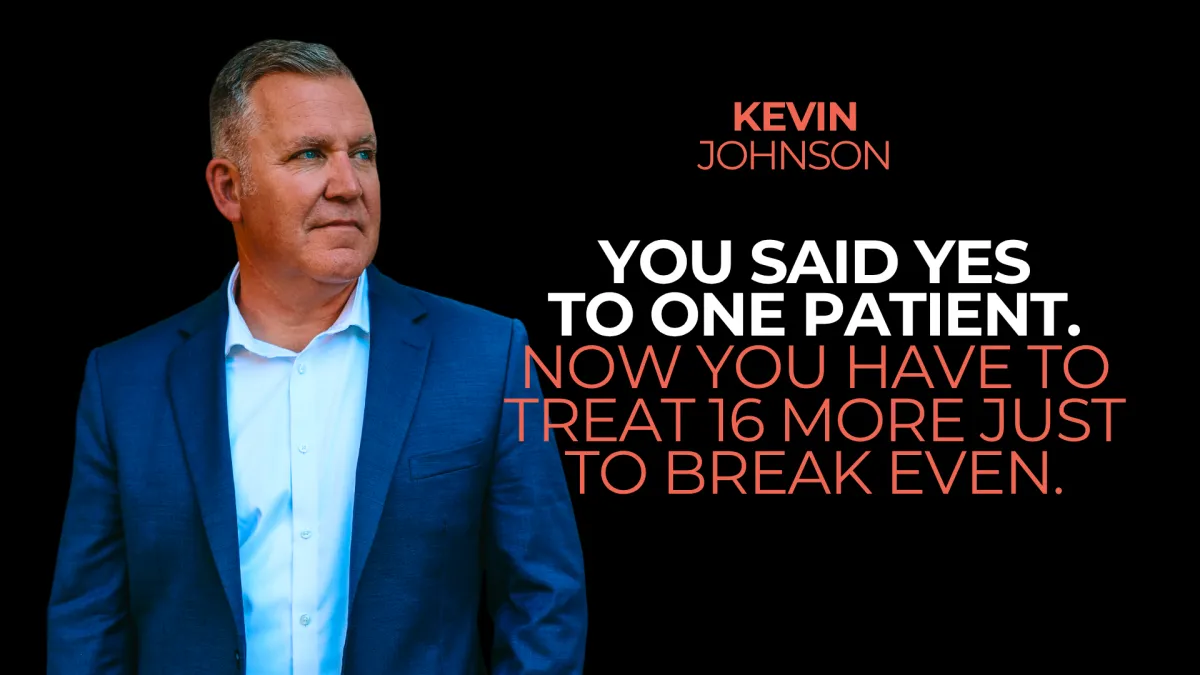
You Said Yes to One Patient. Now You Have to Treat 16 More Just to Break Even.
Read that again. Because most practice owners never see it this way until someone puts the math in front of them.
You have a patient sitting in your chair. A $15,000 treatment plan. They push back. They negotiate. They tell you they can't afford it or they'll think about it or they know someone who got a better deal somewhere else. And you, because you want to help them and you want to keep them, write off $6,000 and get them to say yes.
It feels like a win. You kept the patient. You got the case accepted. You did the right thing.
You didn't. And the math is going to show you exactly why.
What You Actually Gave Away
Here is the part that almost nobody fully understands. Your overhead doesn't disappear when your revenue does.
When you wrote off that $6,000, your staff still got paid for that appointment. Your rent was still due. Your supplies were consumed. Your lab bill arrived. Every single cost associated with delivering that treatment was still incurred in full. You gave away $6,000 of revenue but not $6,000 of expense.
That means the $6,000 you wrote off did not come out of your gross production. It came directly out of your profit. Dollar for dollar. No overhead buffer. No margin to absorb it. Straight out of the bottom line.
And now that $6,000 hole in your profit has to be filled. Not with wishful thinking. With production. Real appointments, real patients, real chair time. All of which carry their own overhead costs.
The Formula Nobody Teaches You
Here is how you calculate what it actually costs to recover a discount.
Take the amount you gave away and divide it by your net margin percentage. That tells you how much additional production you need to generate just to get back to zero.
At 60% overhead your net margin is 40%. A $6,000 giveaway requires $15,000 in additional production to recover.
At 75% overhead your net margin is 25%. That same $6,000 giveaway now requires $24,000 in additional production to recover.
Let that land for a moment. The identical discount. The identical dollar amount written off. But because this practice is running at 75% overhead instead of 60%, it costs $9,000 more in production to recover. That is a 60% increase in the recovery burden for the exact same act of generosity.
And 75% overhead is not an outlier. It is the reality for a significant number of the practices I work with, many of them carrying the additional weight of systemic insurance write-offs that are already compressing the margin before a single patient-level discount is applied. When you layer a $6,000 giveaway on top of an already thin margin you are not adding one problem. You are compounding an existing one.
Now Turn It Into Patients
Let's make this tangible. Using an average treatment plan value of $1,500 per patient here is what that recovery actually looks like in your schedule.
At 60% overhead you need $15,000 in additional production to recover the $6,000 discount. At $1,500 per patient that is 10 patients who sit in your chair, consume your staff's time, use your supplies, generate lab costs, and contribute nothing to your bottom line. Every single one of them is working off the debt created by the one patient you said yes to.
At 75% overhead you need $24,000 in additional production. That is 16 patients treated at full cost with zero contribution to profit. Sixteen appointments. Sixteen sets of supplies. Sixteen lab bills. Sixteen uses of chair time that could have been generating real margin. All of it burned to recover what one conversation cost you.
You made one patient happy. It cost you the profit equivalent of treating 16 patients for free.
The Ripple Effect Nobody Sees Coming
This is where most practice owners lose the thread because the ripple does not announce itself. It just quietly reshapes your month.
You write off $6,000 on a Tuesday. By Thursday you are scheduling more aggressively to fill the gaps. By the following week you are wondering why collections feel light even though the schedule looks full. By the end of the month the overhead percentage is higher than it should be and you cannot quite identify why. You did not connect the dots back to Tuesday because nobody showed you the math.
The ripple looks like this. One discount creates a profit hole. The profit hole requires additional production to fill. Additional production requires additional appointments. Additional appointments require staff time, supplies, chair availability, and clinical energy. All of that has a cost. And because you are operating at 75% overhead, a significant portion of every dollar generated by those recovery appointments goes right back out the door in expenses before it ever reaches your bottom line.
You are essentially running faster on a treadmill that is already moving too quickly just to get back to where you were before you said yes.
What the Reports Actually Show
In over 25 years of working with dental practices I have pulled a lot of reports. Production reports. Collection reports. Adjustment reports. Write-off summaries. And the numbers that show up in that last category are the ones that stop practice owners cold when they finally see them clearly.
I have seen practices where the doctor is giving away $50,000 annually in discounts and write-offs. I have seen $150,000. I have seen practices where the number exceeds $300,000 in a single year. And in almost every case the owner had no idea the number was that high because nobody had ever shown it to them in one place at one time.
Now take the scenario we just walked through. One patient. One $6,000 discount. Sixteen patients worth of production required just to recover it at 75% overhead.
If a practice is giving away $150,000 annually in discounts and write-offs at that same overhead level, the recovery math becomes staggering. That is $600,000 in additional production required every single year just to get back to zero. That is not growth production. That is not building the practice. That is running as hard as you can just to recover what was given away.
At $300,000 in annual write-offs the number exceeds $1,200,000 in required recovery production. Every year. Before a single dollar of real growth is possible.
And yet the schedule feels full. The team is busy. The owner is exhausted. And nobody can explain why the bank account does not reflect the effort being put in.
This is why.
Three Things I Want You to Walk Away With
Before I close this out I want to make something clear because I can already hear the pushback forming.
First, I am not suggesting you never help someone out. I am not suggesting you become a practice that turns away patients who are genuinely struggling. I believe completely in the act of helping someone who is in real need. When you do that you are just being a good human. Full stop. That is not what this post is about.
Second, and this is the point of everything you just read, you need to know how much extra work you are creating for yourself every single time you offer a discretionary discount. Not an insurance write-off. Not a contractually obligated adjustment. A discretionary write-off, a number you chose to reduce because a patient pushed back or because the conversation got uncomfortable. That is what we are talking about. And the math does not care about the reason. Every dollar of discretionary discount generates a recovery burden that your team has to work off before the practice sees a single dollar of real profit. Now you know what that burden actually looks like in patient volume, in chair time, and in production. You cannot unknow it.
Third, in the moment you offer that discount you are not just giving something to that patient. You are taking something away. From your future. From your team's ability to earn what they deserve. From your family and the retirement you have spent your career building toward. One conversation. One moment of discomfort avoided. And the ripple runs further than most owners ever see.
Help people when they need it. Know the true cost when you do. And make the decision deliberately instead of by default.
Let's talk.