
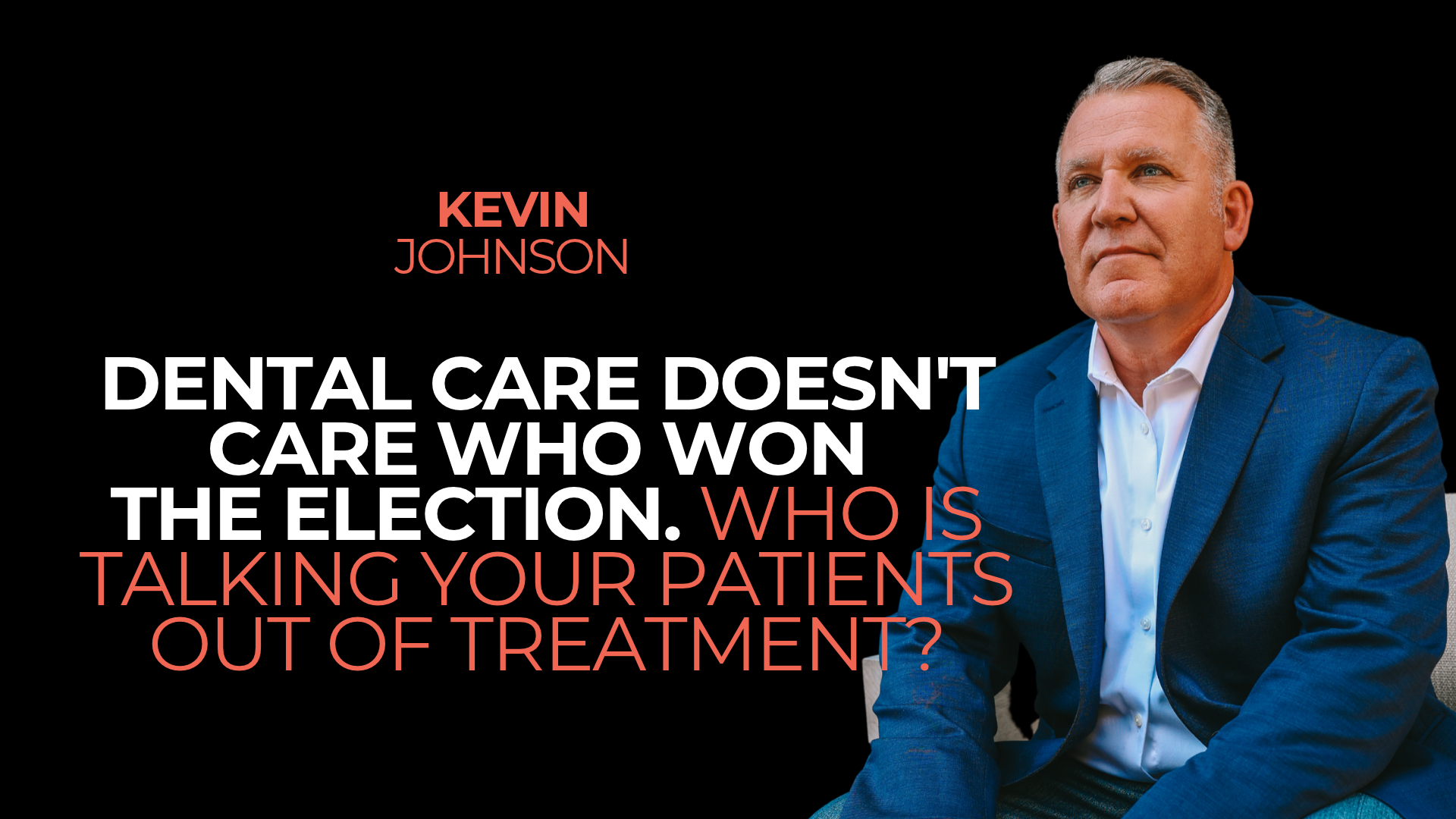
Dental Care Doesn't Care Who Won the Election.
Now that the elections are over, how do you believe they affected you?
If you're wondering whether this is about politics, it isn't. Politics touches all of us, and we tend to think of it as pure policy, something that shapes the cost of living down the road. It can also hit you in the moment, financially, and my guess is you felt it sooner than that.
In one day, I spoke with four practices that were having a less than stellar month. I had told each of them in advance that it was possible, and I explained how they could lessen the likelihood of it hitting them, or eliminate it altogether. I've watched this pattern since the 2016 presidential election, about ten years now, and in my experience it has only gotten worse, because of the media and because of social media.
I have no interest in a political debate here. The point is how outside factors can influence your business, and how yours can be affected less than others. It comes down to systems, mindset, and your team.
And here is the part of "your team" I want you to keep in mind from this paragraph to the last. It's your team members' own personal financial situation, or simply their views on finances. We don't all spend money the same way, and we can't assert our own personal views on other people. What feels like a lot of money to one person is nothing to another. Hold on to that as you read.
Dental Needs Don't Change During Election Season
I don't have to preach to you that people's dental needs don't go away because of an election, the economy, or the news cycle. Patients may adjust their priorities and rethink where their discretionary money goes, and that's fair. But the needs your team identifies are the same ones they identified before the campaigns started, and how your team presents them shouldn't change either.
Maybe I'd debate myself on that. If it should change, it's in one direction only. Your team should become more assertive with recommendations, not more withdrawn.
So Who Is Talking Your Patients Out of Treatment?
There are two answers, and most practices only look for one.
The first voice is inside your practice. Your team's personal financial situation, or just their views on finances, will often influence how they talk about treatment needs. A team member who is stretched at home may soften a recommendation, hesitate over a number, or quietly decide a patient can't afford it. A team member who is frugal by nature may see a treatment plan as extravagant, when the patient across the desk sees it as an easy yes. Nobody means to do it. But the patient never hears the full story, and the treatment goes undone.
Fix a small cavity now and it's one thing. Leave it, and it can become a root canal, a crown, or an implant later. That's common sense when you're the professional. How we communicate it decides whether the patient understands why now beats later. Skip a $100 oil change and the $5,000 motor replacement suddenly makes the oil change look cheap. Dentistry works the same way. Be your patient's best advocate.
The second voice is outside your practice, and it has a microphone. Here are five of them.
Dr. Mehmet Oz and The Dr. Oz Show, an Oprah Winfrey protégé. He is a cardiovascular surgeon with his own syndicated television show. His 2010 thyroid cancer episode said part of the rise in thyroid cancer could be due to radiation from dental X-rays and mammograms, and the ADA's position was that the exposure from dental X-rays is quite small. One dental professional wrote that many patients refused dental X-rays altogether because of that one episode. radiologytoday.net +2
Netflix and "Root Cause," produced by Justin Lyons. The documentary alleged that infections in root canal treated teeth cause serious illness and told viewers to have those teeth removed. The ADA, the American Association of Endodontists, and the American Association for Dental Research warned the media companies hosting it that it could harm the public, and Netflix removed it less than a month after its release. Lyons, the film's producer, claimed the dental associations' pressure got it removed. claim about root canals causing serious illness no +2
Gwyneth Paltrow, founder of Goop. She told WSJ Magazine that she starts every morning oil pulling, and searches for oil pulling spiked the next day. The ADA says there are no reliable scientific studies showing that oil pulling reduces cavities, whitens teeth, or improves oral health. aolnewbeauty
Charcoal toothpaste influencers on TikTok and Instagram. ADA News experts stressed that influencers without dental backgrounds keep spreading misinformation, and noted that activated charcoal can be abrasive and wear down enamel over time. ada
DIY gap-closing rubber bands from viral TikTok and YouTube creators. One TikTok creator told almost nine million viewers she closed her tooth gap in three days with hair ties. Orthodontists warn that these attempts could lead to gum irritation, misalignment, and tooth loss. A survey by the American Association of Orthodontists found that nearly 13% of its members were seeing patients who had tried DIY teeth straightening. Experts warn against TikTok's 'dangerous' DIY dental hack: 'You could lose a tooth' +2
Every one of them had a huge audience, and many had little or no credibility in the clinical area they were speaking to. Visibility is not credibility. Whoever holds the microphone isn't always the one who understands the dentistry. You are.
What to Do This Week
Ask your team, honestly, how they feel presenting larger treatment plans right now, and listen for hesitation.
Make sure everyone who presents treatment can separate their own financial situation and views on money from the patient's needs.
Ask your patients where they get their health information, and be ready to answer what the online experts told them.
Rehearse the first two minutes of your treatment conversations so they sound the same whatever is in the news.
Back Where We Started
Remember where this began. The outside voices are loud, but the one most practices never examine is the quiet one at the front desk, the treatment coordinator's desk, or the chairside. Your team member's financial situation is theirs, and their views on money are theirs. A patient has a different situation and different views, and we don't all spend money the same way. The moment a team member's personal budget decides what a patient hears about their own care, the patient loses an advocate.
Who This Is For
Dentists, specialists, managers, and key team members in any dental specialty, whether general, oral surgery, orthodontics, periodontics, endodontics, pediatrics, or prosthodontics. Your patients have plenty of loud voices telling them what to think about their health. They need one voice they can trust, and that voice is yours and your team's.
If you'd like help building a team that presents needs with confidence no matter what is in the headlines, let's talk.
Written by Kevin Johnson, CEO and Founder of Leverage Consulting.